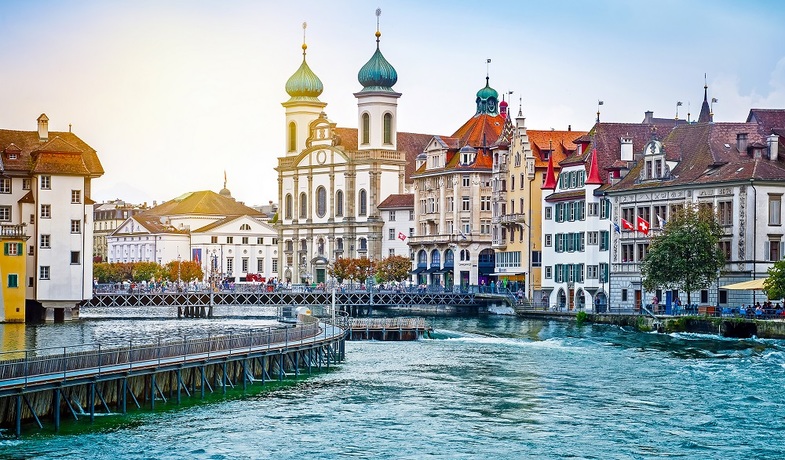
Switzerland

Residency By Investment

150,000 Swiss francs
Lump-Sum Taxation
Mobility

172
Visa Free Travel
Switzerland Independent Means Visa Overview
Switzerland offers a residence permit for financially independent individuals who do not intend to take up employment in the country.
The permit is available to both EU/EFTA nationals and third-country nationals, though the conditions, permit duration, and financial thresholds differ significantly between the two groups.
Both routes require proof of sufficient financial means and comprehensive health insurance. The permit does not confer the right to work in Switzerland.
The program is administered at the cantonal level, meaning requirements, processing, and lump-sum tax arrangements vary by canton of residence.
Applicants must be prepared to reside in Switzerland for the greater part of the year, though flexibility is available for frequent travelers.
Family sponsorship extends to the applicant’s spouse and dependent children, who receive a B permit under the same application.
Eligibility Requirements
Requirements are set jointly by cantonal migration authorities and the federal State Secretariat for Migration (SEM).
All applicants must demonstrate sufficient financial resources, hold comprehensive Swiss health insurance, and refrain from any gainful employment within Switzerland.
Two tracks apply depending on nationality, as follows:
EU/EFTA Nationals
- Applicants must prove sufficient financial resources to support themselves and any accompanying family members without relying on Swiss social assistance
- The minimum income threshold for a family is generally around CHF 50,000 (approx. US$63,000) per year, though cantons may apply higher thresholds
- Proof of accommodation in Switzerland is required, whether owned or rented
- A clean criminal record is required
- No employment or regular economic activity within Switzerland is permitted; passive management of investments, board membership in foreign companies, and non-Swiss economic activities may be permitted, subject to cantonal assessment
- EU/EFTA nationals receive a B permit initially valid for five years, renewable provided conditions continue to be met
Third-Country (Non-EU/EFTA) Nationals
- Applicants must demonstrate substantial financial resources; the threshold is higher than for EU/EFTA nationals and is assessed on a cantonal basis
- A close personal connection to Switzerland is required and assessed independently of family ties; examples include active participation in local associations, cultural engagement, or other socio-cultural links to Switzerland
- Proof of accommodation in Switzerland is required
- A clean criminal record is required
- No employment or economic activity within Switzerland is permitted
- Third-country nationals receive a B permit initially valid for one year, renewable annually provided conditions continue to be met
- Third-country nationals wishing to apply for lump-sum taxation must be taking up Swiss residence for the first time or returning after at least ten years abroad, and refrain entirely from any Swiss employment or business activity
Route to Citizenship
Holders of a residence permit for independent means become eligible to apply for a C permit (permanent residence) after 10 years of lawful, uninterrupted residence in Switzerland. EU nationals may qualify after five years.
The C permit is a prerequisite for ordinary naturalization and is not automatically granted; cantonal authorities assess integration, language proficiency, financial stability, and criminal record before issuing it.
Ordinary naturalization requires a minimum of ten years of total legal residence in Switzerland, of which at least three of the five years immediately preceding the application must have been spent in the country.
Applicants must hold a C permit at the time of application, demonstrate proficiency in at least one of Switzerland’s national languages at A2 written and B1 oral level in the language of their canton, pass a civics and integration assessment covering Swiss history, geography, and political institutions, show financial stability with no outstanding debts or criminal proceedings, and demonstrate integration into Swiss social and civic life.
Processing typically takes two to three years and involves approval at the communal, cantonal, and federal levels.
Switzerland permits dual nationality, so applicants are not required to renounce their existing citizenship, provided their country of origin also permits dual citizenship.
Mobility and Taxation
Mobility
Residence permit holders benefit from the right to live in Switzerland and to travel freely within the Schengen Area for stays of up to 90 days in any 180-day period across all Schengen member states without a separate visa. Switzerland is a Schengen member, though not an EU member state.
Upon naturalization, Swiss citizens hold one of the most powerful passports in the world, with visa-free or visa-on-arrival access to approximately 185 countries and territories. This includes visa-free access to all EU and EEA member states, the United States, the United Kingdom, Japan, Canada, Australia, and the United Arab Emirates, among others.
Taxation
Switzerland operates a lump-sum tax regime, known as the forfait fiscal, available to qualifying residents who hold non-Swiss citizenship, are taking up Swiss residence for the first time or returning after a minimum absence of ten years, and do not engage in any employment or business activity within Switzerland.
Under this system, tax liability is calculated not on actual income but on an assumed income derived from living expenses.
The tax base is determined as the highest of three measures: seven times the annual rental value of the applicant’s Swiss residence, three times the cost of hotel accommodation if the applicant lives in a hotel, or a federal minimum of CHF 434,700 (approx. US$550,000) as of 2025.
In practice, annual tax bills range from approximately CHF 250,000 (approx. US$316,000) to CHF 1 million (approx. US$1.27 million) depending on the canton.
However, not all cantons participate in this special tax regime; Zurich abolished lump-sum taxation in 2010 and Basel followed in 2012.
Residents who do not opt into the lump-sum regime are subject to Switzerland’s standard progressive cantonal and federal income tax rates, which vary by canton.
How to Apply
The Swiss Residence Permit for Persons of Independent Means is administered by the cantonal migration authority of the applicant’s intended canton of residence, under the oversight of the Federal State Secretariat for Migration (SEM).
There is no single national application portal; applications are handled at the cantonal level, and requirements vary between cantons.
EU/EFTA nationals apply directly upon or after arrival in Switzerland. Non-EU/EFTA nationals must obtain a national long-stay visa (Type D) from the Swiss embassy or consulate in their country of residence before entering Switzerland, following cantonal pre-approval.
The typical process runs as follows.
- Step 1. The applicant selects a canton of residence and contacts the relevant cantonal migration authority to confirm the applicable financial thresholds, lump-sum tax conditions, and documentation requirements specific to that canton.
- Step 2. The applicant secures accommodation in Switzerland, either by purchasing or renting a property, as proof of housing is required before a permit application can be submitted.
- Step 3. Non-EU/EFTA nationals submit a pre-approval application to the cantonal migration authority from their country of residence, including proof of financial means, proof of accommodation, a valid passport, a criminal record certificate from each country of residence in the past five years, and proof of comprehensive Swiss health insurance.
- Step 4. Following cantonal pre-approval, non-EU/EFTA nationals apply for a Type D long-stay visa at the Swiss embassy or consulate in their country of residence; EU/EFTA nationals proceed directly to entry without a visa.
- Step 5. Upon arrival in Switzerland, the applicant registers with the residents’ registry of their commune of residence within 14 days of arrival.
- Step 6. The applicant submits a formal residence permit application to the cantonal migration authority, accompanied by the full documentation set; the cantonal authority issues the B permit following review and identity checks.
- Step 7. Applicants wishing to benefit from lump-sum taxation negotiate the applicable tax base directly with the cantonal tax authority at the time of taking up residence; the arrangement is agreed before or upon arrival and cannot be established retroactively.